


Blog
When Bridge City Bicycle Co-op Leaves the Tool With the Learner
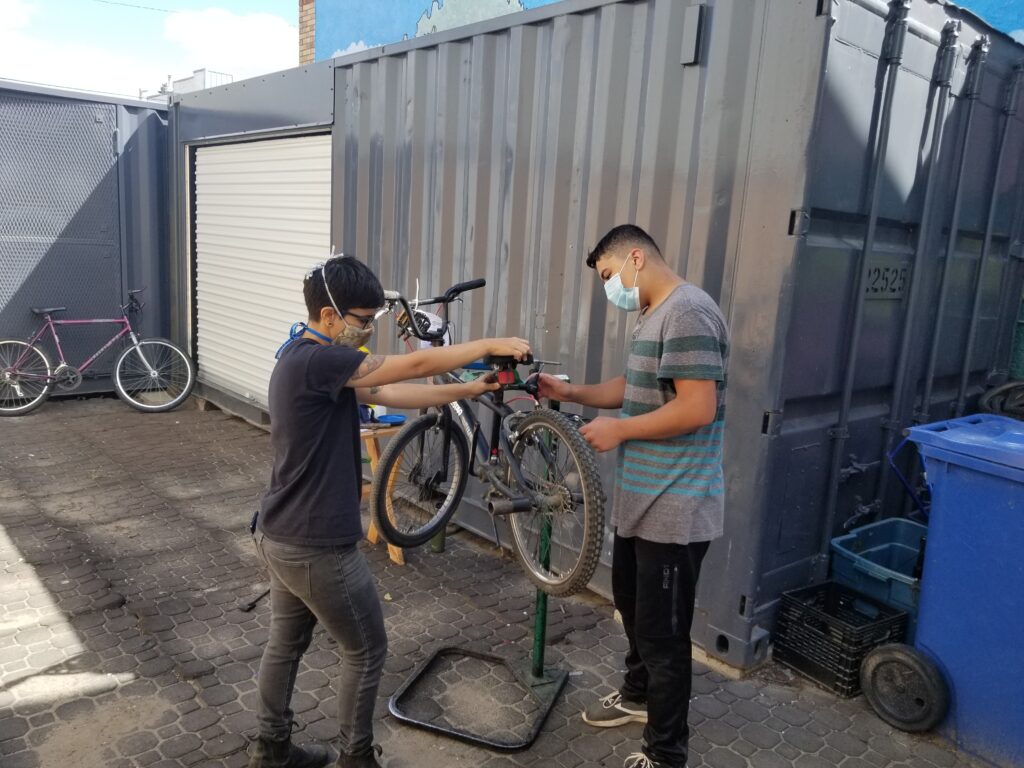
A Youth Build-A-Bike session at Bridge City Bicycle Co-op. Photo courtesy of Bridge City Bicycle Co-op.
The member had the tool, and Zain Abidin left it with them. In an email interview, Abidin of Bridge City Bicycle Co-op recalled an Open Hours repair in which someone working on a loose bottom bracket struggled to judge how much force to use.
Abidin described that member’s starting point: “Never worked on one before, and they didn’t even know it was a problem until we pointed it out the week prior.”
He said he demonstrated part of the work, then handed over the tool and kept explaining while the member used it. Abidin described the outcome this way: “The whole thing took about 25 minutes. The member left knowing they could do it again.”
For Abidin, handing over the tool still leaves a volunteer with a decision: “We don’t have a hard and fast rule. It’s a judgment call the volunteers get to make.”
“The guideline we share with new volunteers is: if they’re making progress, even slowly, let them keep going. If they’re stuck in the same spot for a couple minutes or about to damage something, that’s when you step in.”
The risk of damage changed that decision in one of Abidin’s examples: “When it mattered: during a Youth Build-A-Bike session, a 13-year-old was trying to adjust a rear derailleur limit screw. They were turning the wrong screw, and the chain was about to jump into the spokes. The volunteer working with the youth stepped in immediately.”
Abidin said the volunteer explained how to distinguish the screws and let the learner try again. He described that intervention plainly: “That was a safety call.”
He set that interruption beside another Open Hours repair: “Contrast that with an adult during Open Hours struggling to get a stubborn crank bolt loose. They were frustrated but making progress with the socket wrench.”
For that adult, Abidin said, the volunteer stayed nearby, provided another tool when asked and let the work continue. With the bottom-bracket repair, the next part of the lesson was finding out what the member could explain afterward.
Abidin said there was no formal test; instead, he recalled asking how the member would recognize the problem again and hearing an answer that named a specific check. The criterion he described was whether the learner could answer this question: “can they explain back what they did, in their own words, without prompting?”